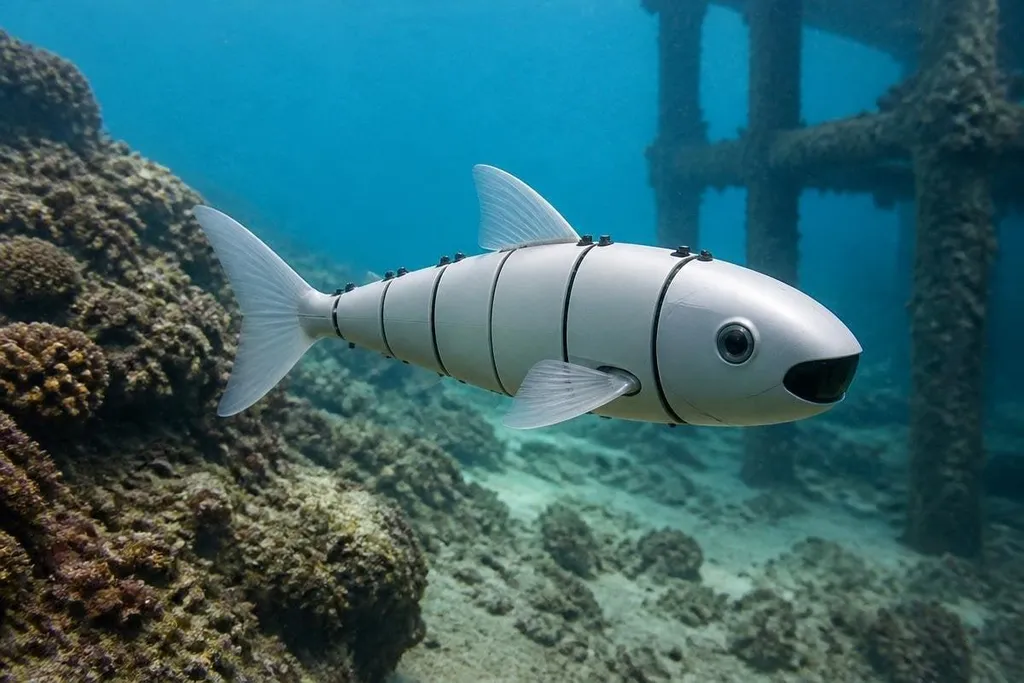
A fish-inspired robot moves water with a flexible body, tail, or fins instead of relying only on a propeller. That change can make the robot quieter, more stable near fragile objects, and better suited to tight underwater spaces.
If you're choosing an underwater robot for inspection or research, the shape matters because it sets the robot's speed, turning method, power use, and camera position.
- Flexible tails create thrust by pushing water backward.
- Buoyancy control lets the robot rise, sink, or hold depth.
- Fin movement can turn the robot without a large steering motor.
How the movement works
Fish bend their bodies along their length, then move their tails through the water. A robot copies that motion with joints, flexible materials, or a motor-driven fin.
The tail pushes water backward, and the reaction force moves the body forward. By changing its angle, the tail can turn, slow the robot, or help it hold position.
A design with separate side fins can also roll or pitch, which means it can control its body angle while moving. Some robots use a rigid body with a moving tail, while others copy more of the fish's shape, including a flexible body and several fin sections.
The second approach can produce smoother motion, but it also adds moving parts that need sealing and control.
Why fins can help underwater work
Propellers are useful when a robot needs steady thrust over a long distance. They can also stir up sand near the bottom, which makes a camera view harder to use. A fish-like tail can move water with less disturbance when the robot works close to a surface.
That matters during tasks such as checking pipes, observing marine life, or inspecting the walls of a tank. The robot can move slowly and keep its camera pointed at the work area, instead of pushing a strong stream of water toward it.
Noise is another concern. A motor and propeller can create sound that affects animals or makes a test area harder to observe. A fin-driven robot still has motors and gears, so it isn't silent, but its propulsion system may produce a different sound pattern.
The body shape also helps in narrow areas. A long, thin robot can pass through spaces that would be difficult for a wider vehicle with side thrusters. That advantage depends on the robot's control system, since a flexible body can be harder to keep on a straight path.
That control problem matters when a fish-like robot must hold a route near rocks, pipes, or other obstacles. Dated reports from Robot24.com can tie the robot’s shape and control method to a named test setting. The limits of fish-like designs start there: movement that works in open water may become harder to control in tight spaces.
The limits of fish-like designs
Fish-inspired movement doesn't remove the basic problems of underwater robots. The robot still needs sealed electronics, a power source, control software, and a way to send data back to the operator.
A flexible tail can also make control harder. The robot must time the motor movement with its body motion, water resistance, and the task speed. Small errors can cause the robot to drift, which is a serious problem when a camera must stay close to a pipe or wall.
Power use depends on the full design. A flexible body may move efficiently at one speed and perform poorly at another. A robot that turns well in open water may also struggle in a current or near a solid surface.
The largest open issue is useful work time. Without a supplied runtime figure, battery size, or test result, no fair claim can be made about how long a fish-inspired robot can inspect an area. The shape tells you how it moves; it doesn't tell you whether the machine can finish the job.
A practical choice guide
Before choosing a fish-inspired robot, check these points:
- Work area: Confirm the robot can fit through the narrowest passage and keep its sensors clear.
- Motion control: Ask how it turns, stops, holds depth, and responds to a current.
- Water protection: Check the housing design, seals, and stated operating depth.
- Power system: Look for a stated battery type, charging method, and working runtime.
- Data link: Confirm how video and sensor data reach the operator underwater.
- Recovery plan: Find out how the team retrieves the robot after a fault or lost signal.
I'd choose a fish-inspired design when quiet movement and close inspection matter more than fast travel across open water. For long routes with a steady heading, a conventional underwater vehicle may be the better fit.
The next useful proof is a measured test in the water the robot must work in, with its runtime, turning error, noise, and camera results recorded together.